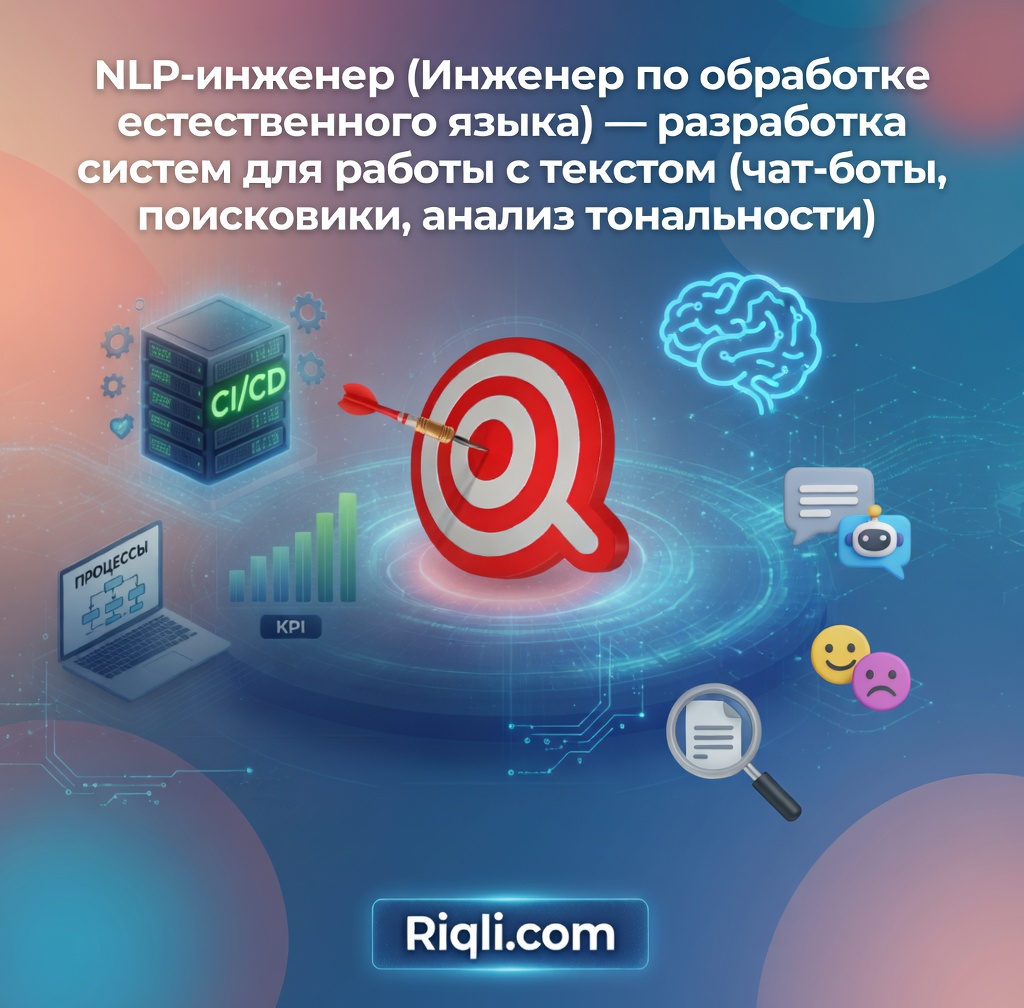
Vous souhaitez devenir ingénieur NLP ou embaucher un spécialiste confirmé du traitement du langage naturel ? Riqli combine les compétences techniques et comportementales, les documents de la profession, les KPI, les processus métier, les certificats, les CV et un modèle d'offre d'emploi. Préparez-vous à un entretien ou publiez une offre dès maintenant.
Ingénieur NLP : profession, compétences et exigences claires avant l'embauche
Un ingénieur NLP (ingénieur en traitement du langage naturel) développe des systèmes pour travailler avec le texte : chatbots, moteurs de recherche, analyse des sentiments et autres solutions NLP. Chez Riqli, la profession est présentée non seulement par le titre du poste, mais aussi par un ensemble connexe de documents de travail, de mesures, de processus, de compétences comportementales et techniques, afin que le candidat et l'employeur puissent voir la structure du rôle à l'avance.
Le profil comprend une description de poste, une carte des KPI, une carte des processus métier, des normes et des bonnes pratiques pour le développement de systèmes NLP, ainsi qu'une notice d'utilisation et de surveillance des services NLP. Cette approche aide à transformer une description de poste en un modèle de compétences clair.
Ouvrir la profession sur Riqli · Voir la profession sur Riqli.com
Que fait un ingénieur NLP : documents de travail de la profession
- Fiche de poste. Ingénieur NLP (Ingénieur en traitement du langage naturel) — décrit les responsabilités du spécialiste liées au développement de chatbots, de moteurs de recherche et d'analyse des sentiments. Avant l'embauche, le document aide le candidat à comprendre le contenu du rôle et l'employeur à formuler des attentes claires.
- Carte des KPI / système d'indicateurs de performance. Ingénieur NLP — relie le travail du spécialiste aux métriques de qualité des modèles, y compris la précision, le rappel, la mesure F1 et la vitesse d'inférence. Cela permet de comprendre à l'avance comment le résultat est évalué.
- Carte des processus métier de l'employé. Ingénieur NLP — montre la séquence de travail : collecte et nettoyage des données, entraînement du modèle, évaluation de la qualité, déploiement et surveillance. Le document est utile pour comprendre le processus de travail avant d'entrer en fonction.
- Normes et bonnes pratiques pour le développement de systèmes NLP — couvre les approches de résolution de problèmes, le travail avec les données textuelles, le prétraitement et la vectorisation. Cela aide le candidat à s'orienter dans les pratiques d'ingénierie et l'employeur à formaliser les exigences.
- Instructions d'exploitation et de surveillance des services NLP — aborde l'exploitation, la surveillance, la journalisation, les métriques de performance du service et la gestion des erreurs. Elle montre que le rôle inclut non seulement le développement, mais aussi le contrôle du service NLP en cours d'exécution.
Quelles qualités de caractère doit posséder un ingénieur NLP
- Pensée analytique et résolution de problèmes complexes — aide à décomposer les tâches complexes, évaluer les options et prendre des décisions éclairées. Pour un candidat, c'est un avantage lorsqu'il travaille sur des problèmes NLP ambigus.
- Développement des compétences en communication et en travail d'équipe efficace — la communication professionnelle, la gestion des conflits et la coopération sont importantes dans le développement collaboratif de produits NLP. La possession de cette compétence rend l'interaction avec l'équipe plus prévisible.
- Répartition efficace des tâches pour atteindre les objectifs — est liée à la gestion du temps, à la planification et à la productivité personnelle. La compétence aide le spécialiste à organiser son travail et à progresser vers un résultat.
- Attention aux détails et concentration lors de travaux précis — la précision, la responsabilité et le soin sont particulièrement importants lorsqu'on travaille avec des données, des modèles et des résultats techniques. Pour un candidat, c'est une confirmation supplémentaire de fiabilité professionnelle.
- Résistance au stress et ponctualité — aide à respecter les délais et à maintenir le rythme de travail face à des tâches changeantes. C'est une qualité importante pour un environnement d'ingénierie.
- Créativité et pensée non conventionnelle — favorise la génération d'idées et la recherche de solutions. Pour un ingénieur NLP, c'est utile lors du choix d'une approche pour les tâches de traitement du langage naturel.
Quelles connaissances doit posséder un ingénieur NLP
- Programmation Python. Structures de données et algorithmes en Python — la base pour le développement de solutions NLP ; comprend les algorithmes, les structures de données, l'asymptotique, la récursivité, les tris, la recherche binaire et les outils Python.
- Contrôle de version Git et GitHub — nécessaire pour le contrôle de version du code et le développement collaboratif, y compris le travail avec les branches.
- Bibliothèques pour le traitement du langage naturel (NLTK, spaCy, Gensim) — couvrent la tokenisation, la lemmatisation, le stemming, l'étiquetage POS et NER, c'est-à-dire les opérations clés du traitement de texte.
- Apprentissage profond pour le NLP (PyTorch, TensorFlow) — comprend les approches par réseaux neuronaux, les transformeurs, BERT, GPT et les outils PyTorch, TensorFlow et Keras.
- Travail avec les bases de données et les stockages (SQL, NoSQL, bases de données vectorielles) — comprend SQL, PostgreSQL, MongoDB, Elasticsearch et les bases de données vectorielles, y compris FAISS. Ces connaissances sont nécessaires pour le stockage et la recherche de données utilisées par les systèmes NLP.
- Développement et déploiement d'API RESTful (FastAPI, Flask, Django) — fournit des connaissances sur REST API, Swagger et OpenAPI, nécessaires pour l'intégration des modèles et services NLP.
- Conteneurisation et orchestration (Docker, Kubernetes) — aide à déployer, mettre à l'échelle et maintenir les services NLP.
- Optimisation des performances des modèles (ONNX, TensorRT, Quantization) — couvre l'optimisation de l'inférence, le pruning, la distillation, ONNX et TensorRT, ce qui est important pour améliorer les performances des modèles.
CV prêt à l'emploi pour ingénieur NLP et certificats en ligne
Avant de postuler, le candidat peut passer des tests basés sur le modèle de la profession sur Riqli.com et obtenir des résultats confirmant les compétences acquises. Les certificats aident à montrer des compétences spécifiques à l'employeur, et les liens vers eux peuvent être partagés publiquement.
L'étape suivante consiste à rassembler un CV et à y joindre des certificats de profession. Vous pouvez créer un CV via Riqli Dashboard CV et partager un lien public via Riqli CV.
L'accès complet au cours coûte 5 $ par mois par abonnement. Les résultats des tests et les certificats restent en ligne pendant la période d'abonnement, et l'hébergement du CV est gratuit.
Ainsi, le candidat reçoit non seulement un CV textuel, mais un ensemble composé d'un CV, de compétences vérifiées et de certificats en ligne disponibles, qui peut être utilisé lors de la recherche d'emploi.
Modèle d'offre d'emploi prêt à l'emploi pour l'employeur
L'employeur peut copier le modèle de profession d'ingénieur NLP dans Riqli et publier un lien vers l'offre sur des plateformes de recherche d'emploi externes. Le modèle peut être adapté à un poste spécifique : modifier les conditions de travail, ajouter ou supprimer les connaissances requises.
Un candidat qui suit le lien voit immédiatement les attentes de l'employeur : compétences, traits de caractère et connaissances professionnelles. Cela rend les exigences du poste plus transparentes avant même le début de la sélection.
Tous les candidats ayant répondu sont affichés dans une liste pratique, où les résultats agrégés des tests sont disponibles. L'employeur obtient une base structurée pour comparer les candidats.
La publication, la copie et la modification des modèles sont gratuites pour les employeurs. Cela permet de commencer à créer une offre sans frais supplémentaires pour le modèle lui-même.
Comment les Documents Vivants créent et mettent à jour le contenu Riqli
Les Documents Vivants permettent de maintenir le contenu de la plateforme à jour et de le développer sur la base des commentaires. Vous pouvez en savoir plus sur la mécanique dans l'article En savoir plus sur les Documents Vivants chez Riqli.
L'approche est axée sur la création de contenu de haute qualité avec un faible coût de mise à jour. Cinq systèmes d'IA — Gemini, DeepSeek, Grok, Qwen et OpenAI — génèrent du contenu sur la base de prompts d'ingénierie.
Les utilisateurs peuvent voter sur les documents, suggérer des améliorations ou recommander la suppression. Ensuite, cinq systèmes d'IA évaluent les recommandations. En conséquence, le contenu évolue grâce à une combinaison de génération automatique, d'évaluation et de retour d'information des utilisateurs.
Utilisez le système qualité pour votre entreprise
Riqli propose une approche de l'organisation de la qualité comme alternative à la dépendance à des auditeurs et conseils coûteux : les modèles d'organisation peuvent être adaptés à n'importe quel secteur. Plus d'informations dans l'article Système qualité dans l'organisation Riqli.
Structure de l'organisation et documents. Les modèles couvrent la structure organisationnelle et les documents, y compris les statuts et la stratégie, les règlements des départements, BPM et RACI, les fiches de poste, les cartes KPI, BPMN/IDEF0, EPC et les listes de contrôle.
Contrôle de l'exécution des processus. Le système aide à organiser l'exécution des processus et à créer des tâches pour les employés, en reliant les exigences au travail pratique.
Gestion de la qualité. L'accent peut être mis sur les équipements, les produits, les documents, les processus et les risques liés au personnel.
Audits internes et externes. Pour les contrôles, des modèles de questions prêts à l'emploi sont utilisés, qui peuvent être appliqués comme base du travail d'audit.
Adaptation à l'organisation. Tout utilisateur peut copier le modèle d'organisation et l'adapter à ses propres tâches et structure.
IA à chaque étape. L'intelligence artificielle aide à créer, analyser et développer les documents de travail du système qualité, en soutenant les processus, de la structure organisationnelle au contrôle et aux améliorations.