AI tomonidan yaratilganOdamlar tomonidan yaxshilangan
Riqli · tirik hujjatlar · doimiy ravishda yangilanadi
AI bilimlari inson amaliyotiga mos keladigan joyda.
Do'stlar bilan baham ko'ring

ATPL 010 Air Law Q&A. Hard skill. (Aviation. Ground training. ATPL. Air. Tutorial. Practice.)
Behind a light plane, a heavy plane is landing. The heavy aircraft is instructed by ATC to reduce 20 kt. Why?
To get a safe order flow of traffic.
Different types of aircraft have varying performance characteristics, including approach and landing speeds. Heavier or larger aircraft, like heavy commercial airliners, often have higher approach and landing speeds compared to lighter general aviation or light aircraft. To provide a safe distance and separation between aircraft, especially in adverse weather conditions or reduced visibility, air traffic controllers may instruct a heavy aircraft to reduce its airspeed. Adjusting the speed of aircraft in the landing sequence helps optimize runway utilization and overall operational efficiency at the airport. The specific instruction to reduce speed by 20 knots is an example of how air traffic control may implement these principles. By slowing down the heavy aircraft, ATC can create a safe and manageable interval between it and the lighter aircraft ahead.
So the heavy can fly over the threshold in the right landing configuration.
To reduce CO2 emission.
To assure wake turbulence separation.
Aeronautical Ground Lights on and in the vicinity of aerodromes may be turned off, provided that they can be brought back into operation ___ before the expected arrival of an aircraft. Which answer correctly fills in the blank space?
1 hour
ICAO Doc 4 444 7.15.2.2 - Lights on and in the vicinity of aerodromes that are not intended for en route navigation purposes may be turned off, subject to further provisions hereafter, if no likelihood of either regular or emergency operation exists, provided that they can be again brought into operation at least one hour before the expected arrival of an aircraft. (ICAO Doc 4444 - Edition 16 - Amendment 7-A - Year 2016)
5 minutes
15 minutes
30 minutes
If an ATC clearance is not suitable to the pilot-in-command of an aircraft the following applies:
The flight crew may request and, if practicable, obtain an amended clearance.
ICAO Doc 4 444 4.5.1 - Scope and purpose of ATC clearances 4.5.1.1 - Clearances are issued solely for expediting and separating air traffic and are based on known traffic conditions which affect safety in aircraft operation. Such traffic conditions include not only aircraft in the air and on the manoeuvring area over which control is being exercised, but also any vehicular traffic or other obstructions not permanently installed on the manoeuvring area in use. 4.5.1.2 - If an air traffic control clearance is not suitable to the pilot-in-command of an aircraft, the flight crew may request and, if practicable, obtain an amended clearance. 4.5.1.3 - The issuance of Air Traffic Control clearances by air traffic control units constitutes authority for an aircraft to proceed only in so far as known air traffic is concerned. ATC clearances do not constitute authority to violate any applicable regulations for promoting the safety of flight operations or for any other purpose; neither do clearances relieve a pilot-in-command of any responsibility whatsoever in connection with a possible violation of applicable rules and regulations. 4.5.1.4 - ATC units shall issue such ATC clearances as are necessary to prevent collisions and to expedite and maintain an orderly flow of air traffic. 4.5.1.5 - ATC clearances must be issued early enough to ensure that they are transmitted to the aircraft in sufficient time for it to comply with them.
The flight crew may propose another clearance. ATC has to amend the clearance in accordance with the pilots request.
The flight crew has to accept the ATC clearance. The clearance is based on the flight plan filed with ATC.
The flight crew may request an amended clearance from the ATC. Amended clearances will only be given when VMC prevails.
Can a pilot use QNH altimeter setting if flying above the transition level?
Yes, if a clearance is obtained to start approach and an intermediate levelling off is not expected.
ICAO Doc 8 168 Basic Altimeter Setting Requirements 2.4 Approach and Landing 2.4.3 References to vertical positioning after approach clearance After approach clearance has been issued and the descent to land is begun, the vertical positioning of an aircraft above the transition level may be by reference to altitudes (QNH) provided that level flight above the transition altitude is not indicated or anticipated. Note.— This applies primarily to turbine engine aircraft for which an uninterrupted descent from a high altitude is desirable and to aerodromes equipped to control such aircraft by reference to altitudes throughout the descent. More information (ICAO Doc 4 444) 4.10.4.5 - A QNH altimeter setting shall be included in the descent clearance when first cleared to an altitude below the transition level, in approach clearances or clearances to enter the traffic circuit, and in taxi clearances for departing aircraft, except when it is known that the aircraft has already received the information.
Yes, if specified flight plan item 18.
Yes, when the difference between the QNH and the standard pressure setting (SPS) is very significant.
Never.
An aircraft on an IFR flight subjected to an act of unlawful interference, with no functioning avionics and complete communication failure. The flight crew should try to proceed on a level which differs from the one normally used for IFR, by:
150 m, when each flight level is 300 m apart.
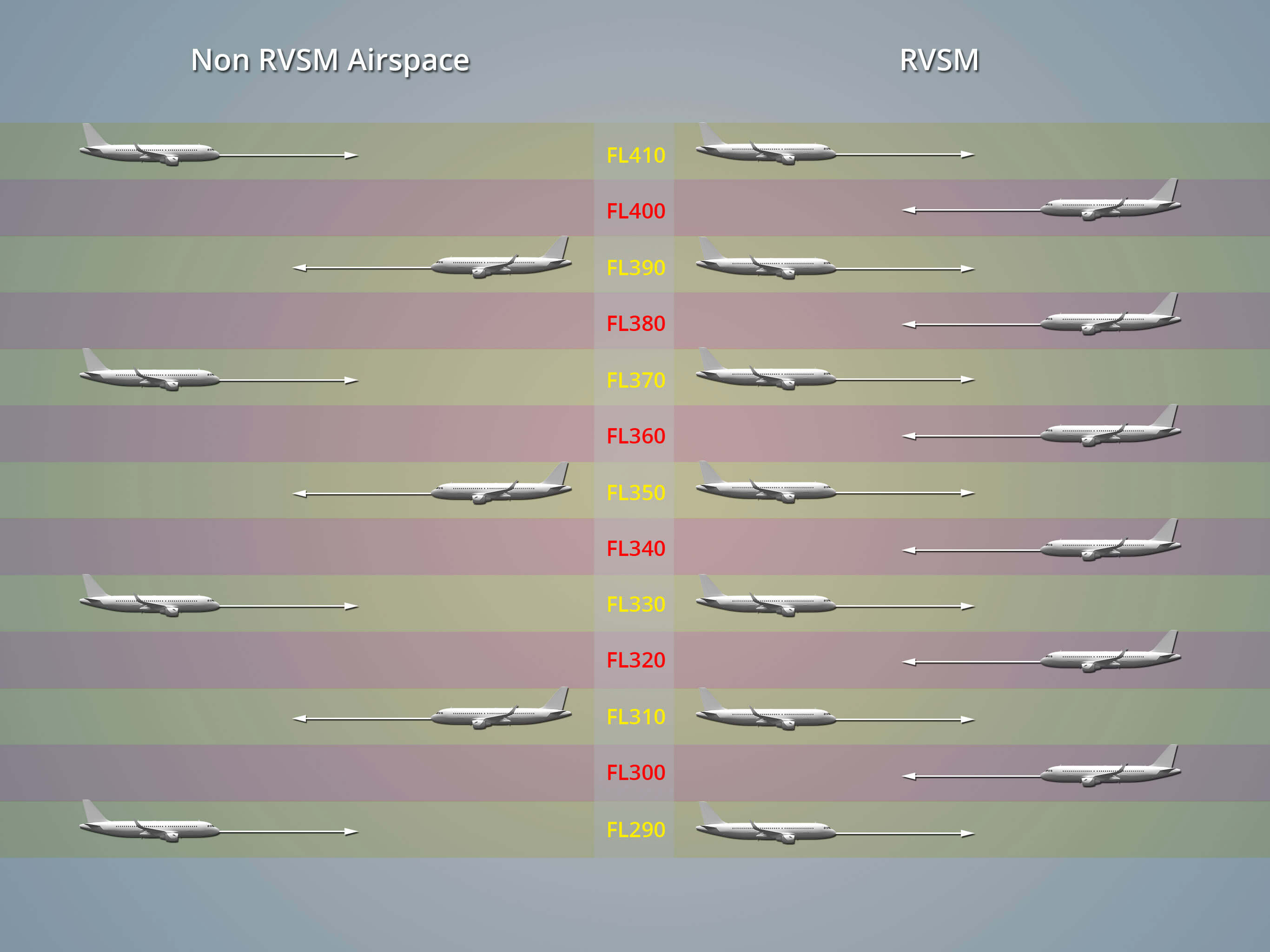
Refer to figure 942. ICAO Annex 2 2.1 Unless considerations aboard the aircraft dictate otherwise, the pilot-in-command should attempt to continue flying on the assigned track and at the assigned cruising level at least until able to notify an ATS unit or within radar coverage. 2.2 When an aircraft subjected to an act of unlawful interference must depart from its assigned track or its assigned cruising level without being able to make radiotelephony contact with ATS, the pilot-in-command should, whenever possible: a) attempt to broadcast warnings on the VHF emergency frequency and other appropriate frequencies, unless considerations aboard the aircraft dictate otherwise. Other equipment such as on-board transponders and data links should also be used when it is advantageous to do so and circumstances permit; and b) proceed in accordance with applicable special procedures for in-flight contingencies, where such procedures have been established and promulgated in the Regional Supplementary Procedures (Doc 7 030 ); or c) if no applicable regional procedures have been established, proceed at a level which differs from the cruising levels normally used for IFR flight by: 150 m (500 ft) in an area where a vertical separation minimum of 300 m (1 000 ft) is applied; or 300 m (1 000 ft) in an area where a vertical separation minimum of 600 m (2 000 ft) is applied
300 m, when each flight level is 150 m apart.
600 m, when each flight level is 300 m apart.
300 m, when each flight level is 300 m apart.
An ACAS RA to descend is issued for an aircraft in climb. The flight crew must follow the RA immediately because the ACAS anticipates:
their response will be correct and timely.
Correct answer: their response will be correct and timely. Chapter 5 OPERATIONAL USE AND PILOT TRAINING GUIDELINES (...) 5.2 ACAS OPERATIONAL USE 5.2.1 ACAS indications are intended to assist pilots in the avoidance of potential collisions and the active search for, and visual acquisition of, conflicting traffic. For ACAS to work as designed, immediate and correct crew response to ACAS advisories is essential. Delayed flight crew response to an RA or reluctance to manoeuvre the aircraft in response to an RA for whatever reason can significantly decrease or negate the protection afforded by ACAS. Therefore, there should be a clear understanding among the flight crew of their respective responsibilities when an ACAS advisory occurs. Flight crews are expected to respond to ACAS indications in accordance with the following guidelines. 5.2.1.1 Respond to TAs by attempting to establish visual contact with the intruder aircraft and other aircraft that may be in the vicinity. Coordinate to the degree possible with other crew members to assist in searching for traffic. Do not deviate from an assigned clearance based only on TA information. For any traffic that is acquired visually, continue to maintain safe separation in accordance with current regulations and good operating practices. Pilots should not make horizontal manoeuvres based solely on information shown on the traffic display. Slight adjustments in vertical speed while climbing or descending, or slight adjustments in airspeed while still complying with the ATC clearance are acceptable. 5.2.1.2 When an RA occurs, the PF (Pilot Flying) should respond immediately by looking at the RA displays and manoeuvring as indicated, unless doing so would jeopardize the safe operation of the flight. The pilot’s instinctive reaction should always be to respond to RAs in the direction and to the degree displayed, without delay. Doc 9863 AN/461 Airborne Collision Avoidance System (ACAS) Manual International Civil Aviation Organization More info TCAS II Resolution Advisories require the pilots to either maintain or change their current vertical speeds. Pilots are required to follow these commands => change the vertical speed accordingly. If this TCAS II RA command is in contradiction with an ATC instruction, the TCAS II RA instructions must always have a priority over ATC instructions. It is because the TCAS II computers in each of the involved aircraft have "agreed" on an optimum conflict resolution => in this way for example one aircraft is issued a CLIMB command, while the other aircraft is issued a DESCEND command. Also, the time allowed for the reaction is relatively short - in case of a Resolution Advisory the time before the potential collision may be as little as 20 second - obviously not enough time to get an ATC clearance first. Therefore it is important to first comply with the TCAS RA and only then advice the ATC.
their response will be correct and within 1 second.
a response within 1 second from the other aircraft in the opposite direction to the RA issued to them.
a timely response from the other aircraft in the opposite direction to the RA issued to them.
On which document is the disinsection of an aircraft certified?
General Declaration
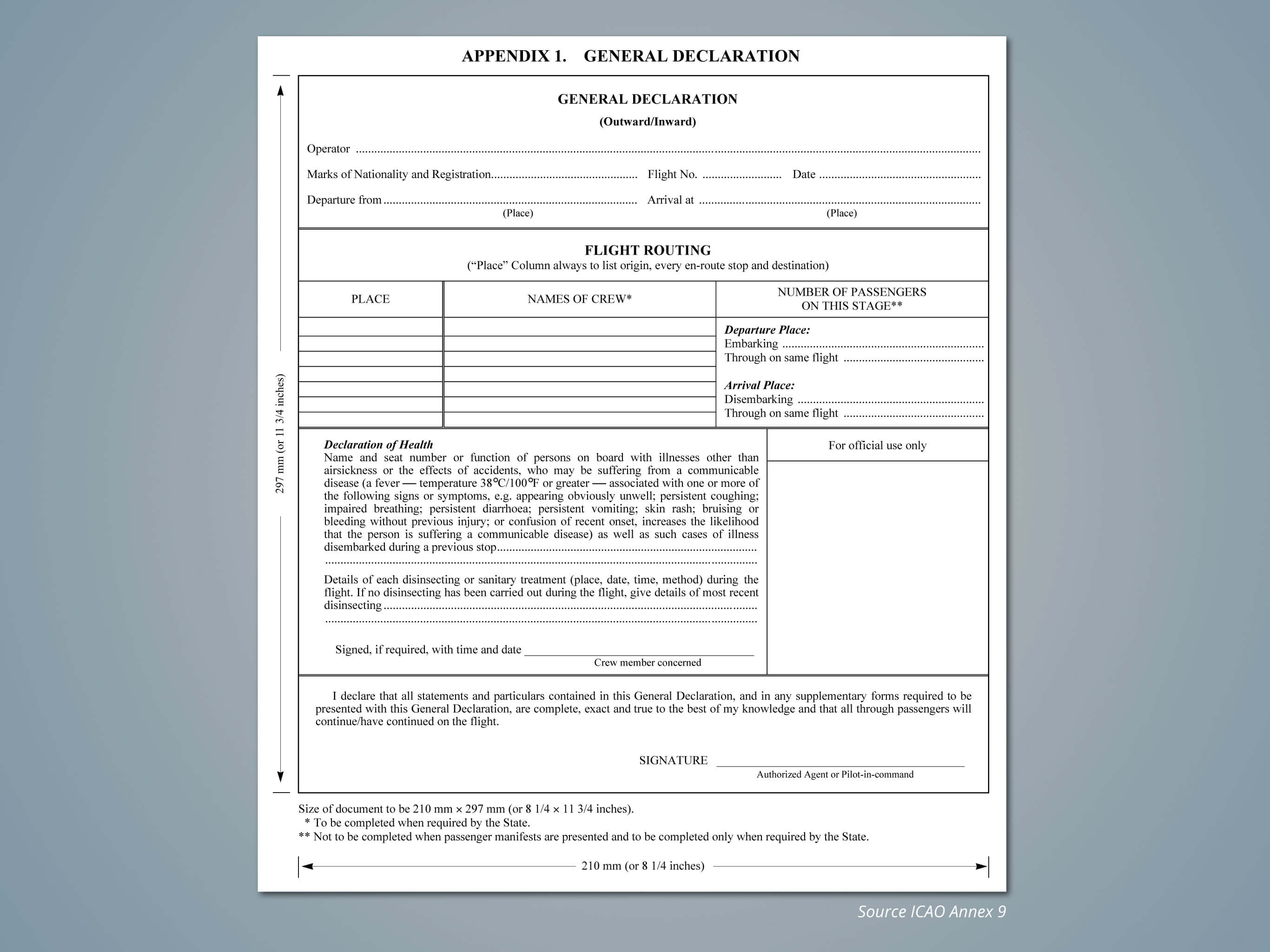
Refer to figure 025. The primary health-related component of the General Declaration is the 'Declaration of Health,' designed to alert authorities to any suspected cases of communicable disease on board. Overall, the General Declaration focuses on public health matters as well as basic information about the crew and passengers. Refer to the explanation picture and find "declaration of Health" in the General declaration: "Declaration of Health Name and seat number or function of persons on board with illnesses other than airsickness or the effects of accidents, who may be suffering from a communicable disease (a fever - temperature 38°C/100°F or greater associated with one or more of the following signs or symptoms, e.g. appearing obviously unwell; persistent coughing; impaired breathing; persistent diarrhoea; persistent vomiting; skin rash; bruising or bleeding without previous injury; or confusion of recent onset, increases the likelihood that the person is suffering a communicable disease) as well as such cases of illness disembarked during a previous stop.... Details of each disinsecting or sanitary treatment (place, date, time, method) during the flight. If no disinsecting has been carried out during the flight, give details of most recent disinsecting" ICAO Annex 9 - Appendix 1 More info ICAO Annex 9 2. Entry and departure of aircraft B. Documents — requirements and use 2.11 A Contracting State requiring a General Declaration shall limit its information requirements to the elements indicated in Appendix 1. The information shall be accepted in either electronic or paper form. 2.19 Contracting States shall not require the aircraft operator to deliver to the public authorities more than three copies of any of the above-mentioned documents at the time of entry or departure of the aircraft. The "above referenced" documents are: General Declaration (Gen Dec) Passenger Manifest Cargo Manifest Stores List. 2.20 If the aircraft is not embarking/disembarking passengers or lading/unlading cargo, stores or mail, the relevant document(s) shall not be required, provided an appropriate notation is included in the General Declaration. (ICAO Annex 9 - Edition 15 - Amendment 27 - Year 2017)
Maintenance Log
Load sheet
Logbook
An airport provides two parallel runways where parallel approaches are conducted with departures interspersed on both runways. What type of operation is this?
Mixed operation
Segregated parallel operations. Simultaneous operations on parallel or near-parallel instrument runways in which one runway is used exclusively for approaches and the other runway is used exclusively for departures. Semi-mixed operations. Parallel operations where one runway is used for departures only and the other one is used for departures and approaches, or, one runway is used for approaches only and the other one is used for departures and approaches. Mixed operations. Parallel approaches with departures interspersed on both runways. Progressive operations. This type of operation does not exist / is not defined by ICAO/EASA. (More info can be found in: ICAO Doc 8168)
Progressive operation
Semi-mixed operation
Segregated operation
"TODA" take-off distance available is: