Created by AIImproved by people
Riqli · living documents · updated continuously
Where AI knowledge meets human practice.
Share with friends
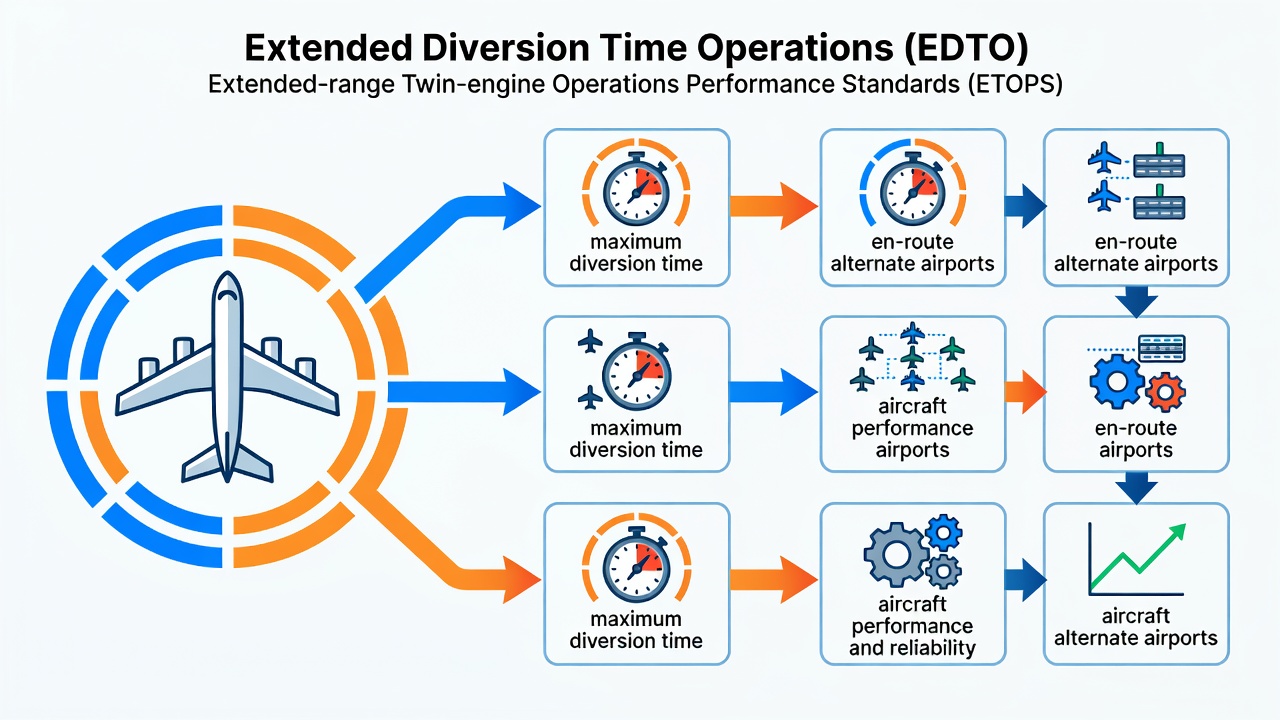
Flight operations manual for EDTO (ETOPS) ATPL Hard skill. (Aviation safety. Extended-range operations. Self-study. Q&A. Questions Answers and explanations. Tutorials. Hard skill.)
Introduction
Abstract.
The course addresses the challenge of safe and regulated extended diversion time operations (EDTO, formerly ETOPS) for transport category aeroplanes with two or more turbojet engines. ICAO Amendment 36 to Annex 6 Part 1 and this Manual introduce uniform standards that allow operators to fly beyond 60 minutes from an alternate aerodrome while maintaining the level of safety achieved through years of ETOPS practice. The target audience of the course includes ATPL pilots, dispatchers, airworthiness engineers and CAA inspectors who need to understand the requirements for Type Design, operational approval, critical fuel, EDTO-significant systems and dispatch procedures. It resolves the uncertainty between the old term ETOPS and the new EDTO, and provides a clear algorithm for obtaining In-service or Accelerated approval.
Course Objective.
Upon completion of this course, you will be able to independently prepare a complete documentation package for obtaining EDTO Operational Approval, calculate critical fuel and maximum diversion distance, select EDTO alternates according to Appendix B weather minima, and ensure compliance with the CMP document and MEL.
Learning Outcomes.
- Know: definitions of Threshold time, Maximum diversion time, EDTO-significant system, EDTO CMP document, Group 1 and Group 2 systems, Time Limited Systems, Critical fuel scenario, In-service and Accelerated approval.
- Be able to: convert diversion time to distance, select EDTO alternates using the weather minima table, calculate critical fuel reserves considering 5% contingency and icing, apply pre-dispatch / post-dispatch / after EDTO Entry Point rules.
- Master: the algorithm for preparing an In-service or Accelerated EDTO application, verification program procedures, oil consumption monitoring, ECTM, reliability program and diversion time rollback when IFSD criteria are exceeded.
Who this course is for.
This course is intended for pilots obtaining or maintaining CLPL Hard skill qualification for extended operations, flight dispatchers, airworthiness engineers, FOI and AWI, as well as airline specialists preparing to open new long-haul routes. It is particularly useful for operators transitioning from ETOPS to EDTO or starting flights with aeroplanes with more than two engines beyond 180 minutes.
The course is not intended for pilots operating only short routes within the 60-minute zone and does not replace official Ops Specs and CMP documents for a specific aircraft type. Theoretical background is provided, but practical approval is always issued by the national CAA.
Module 1. Definitions and Key EDTO Concepts
The central definition of EDTO (Extended Diversion Time Operations) is any operation of an aeroplane with two or more turbojet engines where the diversion time to an en-route alternate aerodrome exceeds the Threshold time established by the State of the Operator. The previously used term ETOPS (Extended Range Operations by aeroplanes with two Turbine Engines) has been retained in the documentation of many States and manufacturers, since Annex 6 explicitly permits its continued use provided that the concept fully complies with the new standards. Threshold time for twin-engine aeroplanes is typically set at 60 minutes, because the maximum diversion of non-EDTO-certified twin-engine aeroplanes is limited to this value. For aeroplanes with more than two engines, Threshold time is typically 180 minutes, since the vast majority of long-range flights over the last 50 years have been conducted within this limit without special requirements. Practical advice: always check the operator's Ops Specs — that is where the specific Threshold time for your airline is recorded.
EDTO alternate — an en-route alternate aerodrome specified in the dispatch or flight release and meeting the dispatch weather and field condition minima. This definition applies only at the planning stage and does not restrict the pilot-in-command's authority in flight. Note: an en-route alternate may simultaneously be a take-off or destination aerodrome. Maximum diversion time — the maximum allowable time (in minutes) from any point on the route to an EDTO alternate at the approved single-engine (for twin) or all-engine (for multi-engine) speed under standard conditions and still air. EDTO critical fuel — the amount of fuel required to fly from the most critical point on the route to the EDTO alternate under the most limiting system failure. These three concepts form the basis of any EDTO route calculation and must be reflected in the operational flight plan.
EDTO-significant system — a system whose failure or degradation could adversely affect the safety of an EDTO flight, or whose continued functioning is critical for the safe continuation of the flight and landing during a diversion. The list includes the electrical system (including battery), hydraulics, pneumatics, fuel system, flight control system, anti-icing, engine starting and ignition, navigation and communications, APU, air conditioning and pressurization, cargo fire suppression, engine fire protection, and emergency equipment. Systems are divided into Group 1 (more important for twin-engine due to the consequences of engine failure) and Group 2 (equally important for twin, tri and quad). For the operator, the Group 1/Group 2 distinction has no practical significance — both groups require the same level of attention in the MEL, verification program and training. Anti-pattern: assuming that Group 2 can be maintained "as usual".
EDTO CMP document (Configuration, Maintenance and Procedures) — a document approved by the Primary Certification Authority, containing minimum requirements for aeroplane configuration, special inspections, life limits, MMEL limitations and maintenance practices necessary to confirm the suitability of the airframe-engine combination for EDTO. The CMP is the "law" for a specific aircraft type: all aeroplanes conducting EDTO must comply with it. In mixed EDTO/non-EDTO operations, the intervals for EDTO-specific tasks must always be observed. Practical advice: before each EDTO flight, technical personnel must verify the current CMP status (including Service Bulletins and MCAI) and confirm that the aeroplane is in EDTO configuration.
Module 2. Policy, Applicability and Approval Procedures
This Manual applies to transport aeroplanes with two or more turbojet engines conducting international commercial operations when the diversion time exceeds 60 minutes and/or the Threshold time of the State of the Operator. Existing ETOPS approvals issued prior to the introduction of the new standards remain valid and do not require re-certification. An application for EDTO Operational Approval must be submitted in advance: 60–90 days for In-service approval and up to 180 days for Accelerated approval. The application must specify: the target EDTO start date, the desired Maximum diversion time, the aeroplane model and MSNs, and the proposed routes. The CAA determines which process to apply — In-service or Accelerated — based on the operator's experience data provided.
For twin-engine aeroplanes, EDTO Operational Approval requires: 1) validation or acceptance of the Type Design and Reliability Approval issued by the Primary Certification Authority; 2) compliance of each MSN (including APU and engines) with applicable CMP requirements; 3) an approved maintenance, reliability and training program incorporating the requirements of Chapter 4; 4) demonstration of proper execution of operational limitations, flight preparation and in-flight procedures of Chapter 3; 5) approval of the route package, diversion time, fleet and area of operations. The complexity of the demonstration is directly proportional to the airline's experience, the degree of in-service experience reduction and the requested diversion time. FOI and AWI jointly analyse the airframe-engine combination and the scope of operations before issuing the Ops Spec.
In-service EDTO approval for twin-engine: an operator with more than one year of direct in-service experience with the aeroplane may request up to 120 minutes; an operator with more than one year of EDTO experience (up to 120 minutes) with the aeroplane may request up to 180 minutes. The required experience may be reduced or increased at the CAA's discretion. Approval beyond 180 minutes requires prior 180-minute approval; beyond 240 minutes — a minimum of two years of experience in 180-minute or longer operations. Accelerated EDTO approval allows EDTO to commence with less than one year of experience or immediately after entry into service, but requires a process validation program (experience transfer, simulated flights, manufacturer or experienced operator support). Beyond 180 minutes always requires actual 180-minute experience.
For aeroplanes with more than two engines, EDTO Type Design certification is not required. A review of the time capabilities of the relevant Time Limited Systems (most commonly the cargo fire protection system) is sufficient. The operator's approval is based on the route package, diversion time, fleet, area of operations, experience, manuals and training. There are no specific diversion time categories or approval methods. Prior to commencing operations, it is necessary to: satisfy the operational approval considerations of Chapter 3, demonstrate established practices, policies and procedures for EDTO flight release, and conduct operational validation flight(s) on the proposed routes (or on an approved simulator with the appropriate scope). Following a positive assessment by FOI and AWI, an Ops Spec with limitations is issued.
Continuity of EDTO certification (twin only): The Primary Certification Authority conducts continuous surveillance of in-service reliability of the world fleet. The certified capability may be reduced, suspended or withdrawn; changes are reflected in the TCDS, AFM and CMP. Continuity of Operational Approval: The operator's CAA monitors the reliability of its EDTO fleet. Procedures and training must be maintained. If the operator ceases actual EDTO operations for longer than the period established by the CAA (e.g., 13 months), a new application is required, unless simulated EDTO processes are maintained. Upon resumption after a prolonged interruption, recurrent training for crews, dispatchers and engineers is mandatory. Minor changes to an already approved program are assessed on a case-by-case basis, without full re-evaluation.
Module 3. Airworthiness and Time Limited Systems
Aircraft Airworthiness Considerations for EDTO include the assessment of Type Design, reliability and the maintenance program of the airframe-engine combination. The objective is to ensure that the design features are suitable for the intended EDTO, that the reliability of relevant systems is sufficient, and that the maintenance program is capable of maintaining the required level of reliability. For twin-engine, EDTO certification is issued by the Primary Certification Authority and is a prerequisite for commencing operations. Certification is always linked to a specific airframe-engine combination and is not indefinite. Existing ETOPS certificates issued prior to the introduction of EDTO remain valid. The main criteria for EDTO certification are detailed in ICAO Airworthiness Manual Doc 9760 Chapter 5; they are not duplicated in this Manual.
The core idea of EDTO certification is to prevent the need for a diversion and to protect the diversion if it does occur. Therefore, reliability objectives are introduced (minimizing failures leading to diversion) and design features that maintain a high level of system functionality. EDTO certification is reflected by the issuance of the CMP document. The CMP may be revised based on in-service experience review. System redundancy levels appropriate for EDTO must be reflected in the MMEL; the operator's MEL may be more restrictive. Maintenance tasks related to EDTO are divided into EDTO Specific (uniquely required for EDTO and listed in the CMP) and EDTO Relevant (affecting an EDTO-significant system and requiring a different interval). Dual maintenance on identical EDTO-significant systems during a single visit must be specially managed to eliminate common cause human failures.
Time Limited Systems for twin-engine: the operating time of the cargo fire suppression system (Class C) and the most limiting other EDTO-significant system must be demonstrated and specified in the AFM, CMP and TCDS. For older ETOPS certificates, the "other most limiting system" is considered to be not less than the approved maximum diversion time. These times must be taken into account during operational dispatch: the flight time to the EDTO alternate (one-engine-inoperative cruise speed, still air, standard day) must not exceed the TLS time minus 15 minutes (for operations up to 180 minutes). For multi-engine, EDTO certification is not required, but the manufacturer must determine the time capability of the most limiting system (usually cargo fire suppression) and reflect it in the documentation. The operator considers this value in the same way as for twin.
Continued validity: The Primary Certification Authority conducts continuous surveillance. If problems are identified, Service Bulletins, new maintenance or procedure requirements are issued, which are incorporated into the CMP or documented as MCAI. If no solution is found, the certified EDTO capability may be reduced, suspended or withdrawn. Operations beyond the revised capability are prohibited. For multi-engine, if the State has introduced its own EDTO certification requirements, similar continuity rules apply through the CMP and Airworthiness Directive process. Practical advice: regularly check the CMP and MCAI status through the manufacturer's and CAA portals — an outdated status is grounds for refusing dispatch of an EDTO flight.
Module 4. Flight Operations: Thresholds, Distances and Approval Levels
Threshold distance and Maximum diversion distance are calculated based on the approved speed (one-engine-inoperative for twin, all-engines-operating for multi) under standard conditions and still air. For the 60-minute threshold for twin-engine, the distance corresponds to 60 minutes of flight at that speed. For multi-engine, the 60-minute threshold is used less frequently; the 180-minute threshold is more common. EDTO Maximum diversion distance is the distance corresponding to the approved Maximum diversion time. All calculations must be reflected in the operational flight plan and navigation documentation. Practical tool: use AFM performance data and approved cruise speeds; never use a TAS other than that approved for EDTO.
Approval levels for twin-engine: Up to 90 min, Beyond 90 up to 180 min, Beyond 180 min, 15% increases. For 90-minute Accelerated: minimum 3 months domestic experience, Type Design ≥120 min, approved CMP, MEL 120 min "ER". For 120 minutes: 6 months EDTO experience, Type Design ≥120 min, CMP, MEL 120 min "ER". For 138 minutes, two paths are possible — extension of 120-minute approval (3 months of 120-minute experience, case-by-case, TLS ≥138+15 min) or using 180-minute Type Design. For 180 minutes: 12 months of 120-minute experience, Type Design ≥180 min, CMP, MEL beyond 120 min "ER". Beyond 180 minutes: existing 180-minute approval, minimization of diversion time, case-by-case for North Pacific (up to 207 min), 240 min for certain oceanic areas, beyond 240 min — 24 months of 180-minute experience (12 of which at 240 min) and Type Design beyond 240.
For multi-engine, operations up to 180 minutes do not require EDTO approval. Beyond 180 minutes, approval is required, taking into account Time Limited Systems and operational considerations. Accelerated EDTO approval is based on a structured program of compensating factors and a step-by-step approach (Appendix C). The main objective of process validation is to transfer EDTO experience into the candidate organisation. Validation may include transfer of experience, simulated EDTO flights, assistance from an experienced operator or manufacturer. The extent of validation is directly dependent on the airline's background and the requested objectives. Practical advice: start preparing for Accelerated approval at least 6 months in advance; Review Gates should be agreed with FOI and AWI in advance.
Module 5. Pre-flight Preparation and In-flight Considerations
Time Limited System Planning: for EDTO up to 180 minutes, flight time to the EDTO alternate (one-engine-inoperative cruise speed, still air, standard day) ≤ TLS time minus 15 minutes. For beyond 180 minutes: either all-engine cruise speed with wind and temperature correction ≤ cargo fire suppression time minus 15 minutes, or one-engine-inoperative cruise speed with correction ≤ other most limiting system time minus 15 minutes. These rules are mandatory for dispatch. Anti-pattern: ignoring the 15-minute "hold, approach and landing" reserve.
MEL for EDTO is based on the MMEL, TC Supplement and CMP. System redundancy levels appropriate for the intended EDTO must be reflected. The operator's MEL may be more restrictive. For Benign Areas of Operation (75 min), special EDTO MEL criteria may not apply. A flight is considered "Dispatched" from the start of the take-off roll; after that, the MEL no longer applies. In the event of any EDTO-significant event prior to the EDTO Entry Point, the crew must contact dispatch for re-evaluation of system capability and possible flight plan changes. The PIC has final authority at all stages.
Communications and navigation: voice communication must be available; if not, alternative systems are required. For beyond 180 minutes, an additional communication system with immediate satellite-based voice (SATCOM) between the crew, ATC and operational control center is mandatory. Non-visual ground aids must provide the required navigation accuracy. Visual and non-visual aids at the EDTO alternate must be in accordance with approved approach types. In the event of known or anticipated solar flare, cosmic radiation or radio blackout, routes are planned to avoid these areas according to the criteria of the Company Operations Manual.
Critical fuel reserves: fuel required to fly from the most critical point to the EDTO alternate under the most operationally critical failure scenario + 15 min hold at 1500 ft + instrument approach and landing. This is compared to the fuel that will be on board at the critical point under normal refuelling. If less, additional fuel is required. Contingency 5% (or 5% wind speed factor if an approved fuel consumption monitoring program is in place). CDL/MEL, anti-ice, ice accretion (or 10% of time if an assessment tool is available), APU/RAT are taken into account. A critical fuel scenario is defined as a failure or combination of failures not shown to be extremely improbable. Example: simultaneous failure of one propulsion system and pressurization → cruise at 10,000 ft (or higher if sufficient oxygen is available) + hold + approach.
EDTO alternate aerodromes: are selected to minimise diversion duration and ensure performance (obstacle clearance) and oxygen requirements. The list and weather limits are published in the Operations Manual. Conditions for designation prior to dispatch: landing distance available, services and facilities, forecast weather ≥ Appendix B minima for the period ±1 hour from the earliest/latest time of landing, crosswind (including gusts) ≤ single-engine limit (or 80% all-engine), ARFF ICAO category 4 (or 7 for beyond 180 if category 4 is available within the diversion time). After dispatch and before the EDTO Entry Point: weather ≥ landing minima, adequacy is verified. After entering the EDTO area: PIC discretion. FIGURE 2 summarises the WX / MEL / Adequacy rules at the three stages.
Module 6. Maintenance, Reliability and Monitoring
The maintenance control system must contain the standards, guidance and direction necessary to support EDTO. The AWI assesses the system for at least 3 months prior to the issuance of the operational approval. EDTO-related tasks are identified on work forms. An EDTO service check is performed by an EDTO-authorized person before each EDTO flight (including simulated). Quality Assurance covers review of technical records, MEL procedures, defect rectification and deferred items. The MCM must be supplemented with all Chapter 4 requirements and submitted to the AWI with sufficient lead-time.
Oil consumption program reflects the recommendations of the Type Certificate holder and takes into account peak and running average consumption, including preceding segments. The APU is included if required for EDTO. Engine Condition and Trend Monitoring (ECTM) describes the parameters, data collection method and corrective action process. The objective is early detection of deterioration, maintaining engine limit margins (rotor speeds, EGT) for prolonged single-engine diversion, taking into account anti-ice and electrical loads. Monitoring is continuous. Verification program ensures that corrective action following IFSD, EDTO-significant system failure or adverse trend is effective (verification flight or other methods). Dual maintenance on identical EDTO-significant systems also requires verification.
Reliability program focuses on EDTO-significant systems, is event-oriented, with reporting of significant events and adverse trends. The AWI is notified at least monthly. In the event of a significant event or adverse trend, the Maintenance Manager has the authority to initiate a rollback of the approved diversion time. If propulsion system target criteria of Appendix A are not met, the AWI is notified; if minimum criteria are not met, the diversion time is rolled back to a value corresponding to the observed IFSD rate. An IFSD may be discounted if it is not related to the operator's or maintenance provider's actions/inaction, or if it is an operational incident (bird strike). Consensus of the operator, AWI and FOI is required. Failure to roll back is grounds for removal of EDTO authority. Reportable events: IFSD/flameout, diversion/turn-back, uncommanded power changes, inability to control engine, significant events/adverse trends.
Propulsion system monitoring: assessment (engine hours, IFSD rate all causes, engine removal rate — 12-month moving average) is provided to the AWI at an agreed frequency. An adverse trend requires immediate evaluation and notification of the CAA. Technical training must include an element addressing the special nature of EDTO; qualified personnel are those who have completed training and performed EDTO tasks under supervision. The parts control program ensures that only parts conforming to the EDTO configuration (including borrowed/pooled parts) are installed on EDTO aeroplanes. Contracted maintenance does not relieve the operator of responsibility.
Module 7. Propulsion System Reliability and Appendix A Criteria
The propulsion system reliability objective is expressed by the formula , where Pe is the engine failure probability per hour, t is diversion time in hours, and 10⁹ is the "lifetime" of the entire fleet. The maximum criterion with tolerance is: . FIGURE 1 provides Minimum Criteria IFSD rates (failures per 1000 hours): 60 min — 0.032, 75 — 0.028, 90 — 0.026, 120 — 0.022, 138 — 0.021, 180 — 0.018. Type Design Approval requires a minimum accumulation of 150,000 engine hours of world fleet experience (may be reduced with compensating factors). Assessment includes all shutdown events, occurrences of low thrust, MTBF, use of reduced thrust and engineering judgment. Corrective actions become part of the CMP.
For Operational Approval, the data is limited to the operator's experience and compensatory experience. The engineering assessment considers the type of power unit, IFSD rate trends (cumulative, 6- and 12-month rolling), the effect of modifications, maintenance actions, environmental exposure, intended maximum flight duration and mean diversion time. Discounting of countable events (IFSD, flameouts, uncommanded thrust reductions) is possible if the event is not EDTO-relevant or corrective action has already been applied; changes are incorporated into the CMP. Practical advice: maintain your own IFSD database with detailed causes — this speeds up the discounting process and protects the diversion time from unjustified rollback.
Module 8. EDTO Alternate Aerodrome and Weather Minima
A distinctive feature of EDTO is the presence of a pre-selected EDTO alternate, to which it is possible to fly after a single or combination of failures. An adequate aerodrome is an aerodrome that meets CAA standards or ICAO Annex 14 and is suitable for the aircraft type. An EDTO alternate is an adequate aerodrome plus weather and field conditions that provide high assurance of a safe approach and landing with an engine/system failed. Weather minima for planning are higher than landing minima. Appendix B Table: 2 or more precision approaches on separate runways — ceiling 400 ft or 200 ft above lowest HAT, visibility 1 sm or ½ sm above lowest; 1 precision — 600 ft / 2 sm; 1 non-precision — 800 ft / 2 sm. BECMG, TEMPO, PROB are interpreted according to special rules (PROB <40% is not limiting, but requires judgment).
Rules for applying minima: before dispatch — Appendix B; after dispatch and before the EDTO Entry Point — landing minima + adequacy check; after entering the EDTO area — PIC discretion. Crosswind (including gusts) ≤ single-engine demonstrated (or 80% all-engine). ARFF: category 4 minimum; for beyond 180 — category 4, if category 7 is available within the diversion time. A 30-minute response time is acceptable with enroute notification. After dispatch, the crew and dispatcher monitor changes at all potential adequate aerodromes along the route. Practical advice: always have a "backup" EDTO alternate in the flight plan — this provides flexibility in the event of deteriorating weather.
Module 9. Accelerated EDTO and Simulated Program
Accelerated EDTO Operational Approval (Appendix C) allows the reduction or replacement of in-service experience provided that process maturity is demonstrated. Required process elements: compliance with CMP, full Maintenance Control System, Oil consumption, ECTM, Verification, Reliability, Propulsion monitoring, Training & Authorization, Parts control, Defect control, Flight planning & dispatch, MEL, Flight crew training. The application plan is submitted at least 6 months in advance. Review Gates are milestones with TCCA visibility/approval. Process validation: processes must be defined, demonstrated (documentation, analysis or simulation) and have a feedback loop. Simulation flights do not commence until training, maintenance systems approval, reliability program and aeroplane EDTO configuration are completed.
Minimum requirements for Accelerated: minimal/no experience for 90 and 120 minutes; 3 months of 120-minute experience for 180 minutes. Further reduction is possible with demonstration of all process elements (simulation or transfer from another airframe-engine). The Simulated EDTO Program (Appendix D) replaces actual 120-minute experience for obtaining 180-minute approval. A minimum of 12 consecutive months of operational experience with the airframe-engine is required before the start of simulation. Sample size ≈1000 flights with ≈3 hours of cruise. Destination reliability ≥98%. All CMP items (except asterisk) are implemented before the start; in the last 3 months — full compliance. Demonstration phase: a minimum of 12 one-way flights on the intended routes ≈90 days before the anticipated approval. Paper airline evaluation in parallel — daily analysis of planned vs actual weather, facilities, wind impact on critical fuel. Validation flight(s) under CAA Inspector supervision.
Practical recommendations for Accelerated/Simulated: 1) start with a gap-analysis of current processes against Chapter 3 and 4; 2) involve the Type Certificate holder for support; 3) document every deviation and corrective action; 4) maintain destination reliability ≥98% — excess non-EDTO operations signal problems; 5) during simulation, immediately stop the exercise in the event of abnormal/emergency; 6) for the first 12 months after approval — enhanced surveillance. Anti-pattern: assuming that experience on another type automatically transfers — validation is still required.
Module 10. Operational Limitations, Manuals and Ops Specs
The area of operation is limited by the maximum approved diversion time to an adequate aerodrome at the approved one-engine-inoperative cruise speed (still air). This is specified in the Ops Spec. The flight dispatch limitation is the maximum diversion time that the operator may use. Procedures must ensure that EDTO is conducted only on routes where the maximum diversion time is respected in still air. In the event of IFSD, the PIC (subject to authority) must promptly divert to the nearest suitable aerodrome. In the event of a single/multiple EDTO-significant system failure — the same applies if continuation does not provide equivalent safety. Contingency procedures never prejudice the final authority of the PIC. The Company Operations Manual must contain minimum altitudes, authorized aerodromes and minima, critical fuel scenario data, and MEL. The Ops Spec must include the approved area of operation and maximum diversion time for each airframe-engine combination. Flights may cross delimiting arcs if the sector is <30 track miles.
Training and evaluation: initial and recurrent EDTO training for flight crew, flight dispatchers and maintenance personnel are established in national Regulations and associated standards. Performance data in the Operations Manual must include detailed single-engine and all-engine data (drift down, cruise, holding, altitude capability, missed approach) for standard and non-standard conditions, as well as any conditions that cause significant deterioration (ice, RAT, thrust reverser). Navigation documentation must allow the location of each Equal Time Point and Critical Point to be determined. Practical advice: regularly conduct table-top exercises with dispatchers and crews on simultaneous engine + pressurization failure and cargo fire scenarios — this is the best way to test critical fuel and alternate selection procedures.
3.11. EDTO (ETOPS) Flight Operations Manual